
A gut feeling: How the microbiome may help protect against disease
May 11, 2026

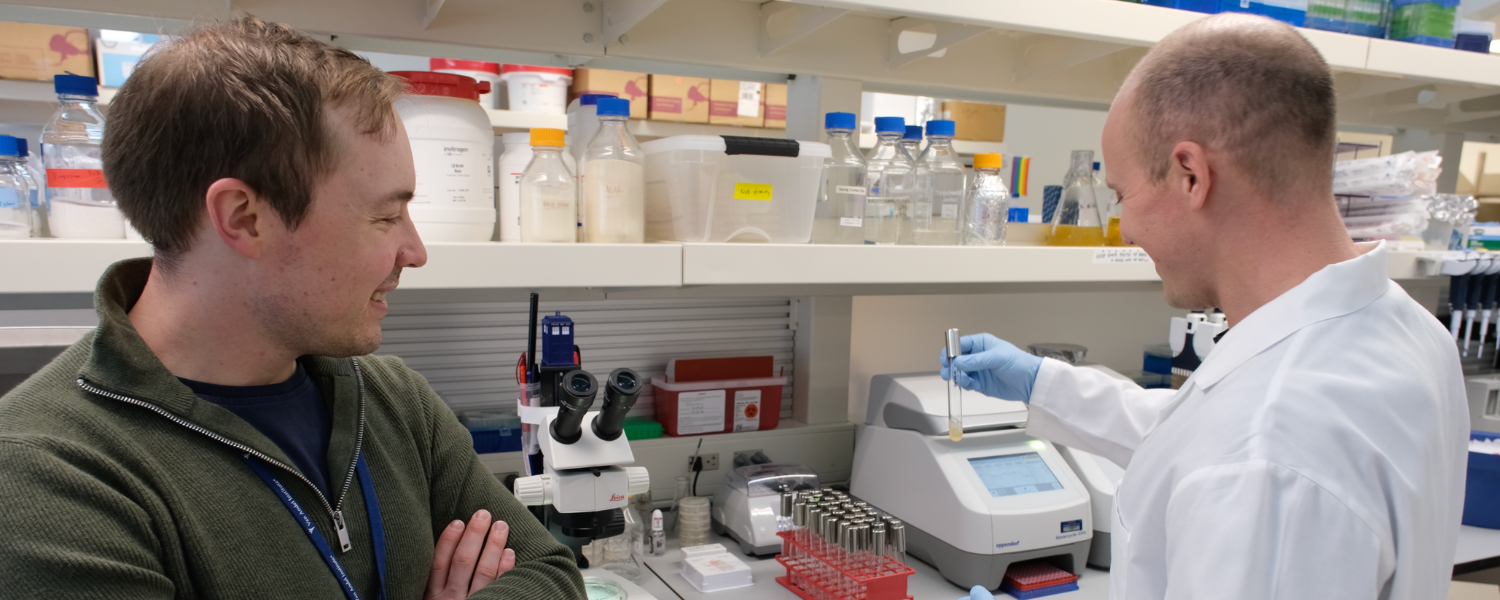
The human gut is home to a vast, invisible ecosystem of bacteria, viruses and other microbes that influence health in ways we are just beginning to understand.
This microscopic community, known as the gut microbiome, helps digest food, regulate the immune system and produce essential molecules that support metabolism.
But one of its most promising roles is perhaps one of the least understood — its potential to promote resilience against illness, even when genetics strongly tip the scale toward disease.

“Most microbiome research focuses on how disruptions to the microbiome contribute to chronic diseases,” said VAI Assistant Professor Dr. Nick Burton. “We’re taking a different approach by exploring the possible protective effects of the microbiome. How might these helpful microbes prevent disease, even when faced with genetic variants that otherwise would cause illness?”
A unique approach
To find answers, Burton’s lab is exploring how the microbiome may temper genetic risk for disease.
“In many ways, our whole-body health relies on the health of the microbiome and its relationship to genetics, diet and other environmental factors,” he explained. “There are some people with disease-causing genetic variants who never actually develop the disease. Something is happening in their bodies that mitigates the genetic risk. Our research suggests the microbiome might be exerting a protective effect.”
Their ally in this search is a microscopic worm called C. elegans. These tiny nematodes are power players in research: They are responsible for two Nobel Prizes in Physiology and Medicine and have contributed to countless discoveries in diseases ranging from cancer to neurodegeneration. About two-thirds of C. elegans genes have a human counterpart, making them an ideal model for studying the interaction between genetics and the environment.
Importantly for Burton and his team, C. elegans feed on bacteria. This simple dietary preference enabled Burton’s lab to develop a robust screening system to study how different microbes affect C. elegans from varying genetic backgrounds.
“Our approach helps us quickly assess different bacteria for their protective potential,” Burton said. “From there, we can prioritize promising bacteria for further study.”
Next steps
Studying how the microbiome guards against disease still is an emerging field, but Burton is optimistic about breakthroughs.
He has good reason to be. In a study published in Nature Communications in December, Burton’s lab revealed how a genetic change in a common gut bacterium promotes buildup of N1-APA, a molecule that affects mitochondrial function in the intestines. Importantly, their research suggests N1-APA may be a link between the genetic change and inflammatory bowel diseases, which affect between 2.4 million and 3.1 million people in the U.S. alone. The findings highlight new opportunities to potentially treat IBD by targeting N1-APA accumulation.1
Learn more about research in the Burton lab ➔
Burton’s lab also has identified several candidate bacteria that could buffer the effects of harmful genetic variants. The team is working to understand how these microbes exert their possibly protective effects.
“Studying the nuanced ways genetics and the microbiome interact helps us move beyond association into causation,” Burton said. “That means more chances to bolster resilience and treat disease by influencing the microbiome.”
Funding Acknowledgment
1 Research reported in this publication was supported by the National Institute of Diabetes and Digestive and Kidney Diseases of the National Institutes of Health under award no. DP2DK139569 (Burton) and a MeNu High Impact Idea Award (MH.004-NOB) from Van Andel Institute Metabolism and Nutrition (MeNu) Program (RRID:SCR_027494). This content is solely the responsibility of the authors and does not necessarily represent the official views of the National Institutes of Health or other funding organizations.